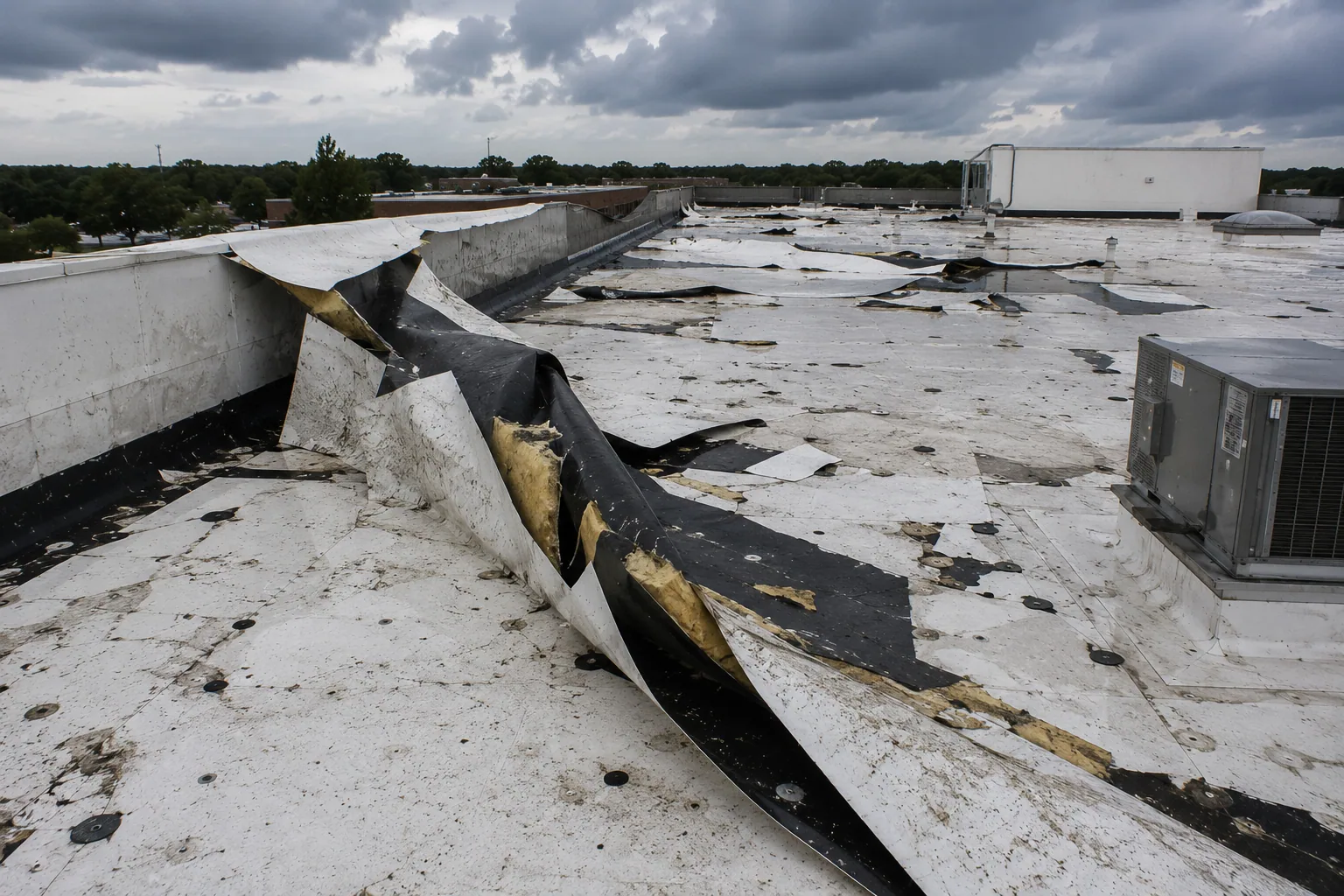
A seam repair costs little per foot and a great deal per repeat visit, so the first job is to learn whether the open seam is an isolated defect or the leading edge of a membrane that has reached the end of its service horizon. One open lap over a loading dock is a repair. Open laps scattered across a field, at different ages of the roof and in different directions, are a finding about the membrane, and the budget conversation changes from patch cost to recover or replacement cost.
For an owner in Waterbury, CT, that conversation takes place against a city the municipal hazard plan describes as exposed to winter storms across its entire area, with summer storms and tornadoes treated as local hazards. Seams are the part of a single-ply or modified bitumen roof that moves most with temperature and wind. The plan is planning context, not a diagnosis; the roof itself shows the pattern, and a probe along each seam records it.
Probe Every Seam Before Pricing a Repair
During a full roof inspection, we run a blunt probe along the edge of each accessible seam and mark every point where it enters. Visible gaps, wrinkles, fishmouths and lifted edges are recorded with a photograph and a roof section number. In a welded system the probe finds weak welds; in a taped or adhered system it finds laps that have lost adhesion. The marks become the quantity schedule: feet of seam to re-weld, re-tape or cover.
The probe also finds what the eye misses. A seam that looks closed can accept the probe over a long run, which tells us the weld was made over dirt or at the wrong temperature. That finding changes the plan, because a long run of weak weld is a different problem than a short gap at a corner. The report separates the two and prices them separately.
Read the Pattern Before Choosing the Scope
Three patterns recur. The first is the localized failure: seams open at corners, around penetrations or at junctions, where stress concentrates and workmanship is hardest. The second is the directional failure: seams open along one side or at one orientation, which often points to movement in the deck or insulation below. The third is the field-wide failure: laps open broadly in many places, which often points to an aged membrane, shrinkage or contamination.
The pattern sets the scope. Localized and directional failures usually call for a repair with a look at what is moving beneath. A field-wide failure points to a recover or replacement, and the written comparison says why, with photographs of the seams that support the conclusion. The owner chooses with the evidence, not with a default.
Match the Repair Method to the Seam Type
A welded thermoplastic seam is repaired by cleaning the area, removing weathered surface where the method calls for it, and re-welding with a probe test after cooling. A taped or adhered seam is repaired by lifting the edge, cleaning and priming the surfaces and setting new tape or adhesive. A modified bitumen lap is repaired by cleaning, heating or priming as the sheet requires, and setting the edge with the compatible method, then embedding a granule or sealing the edge.
Where the sheet is too aged to take a bond, the repair uses a cover strip that carries the water path over the seam, and the report records it as a stopgap for the next capital window. We do not call a cover strip a final fix. We list it with its expected life, the date it should be reviewed, and the section it protects.
Seams at walls, curbs and drain collars receive a second look after the repair, since a seam that ends at a flashing is the point where two details must agree. The photograph of each junction is taken before the area is covered, and the closeout file shows it beside the probe result.
Trace the Cause Under the Seam
A seam repaired without finding the cause will open again. Causes include a billowing sheet that flexes the seam under wind, a fastener that has backed out and lifts the edge, ponded water that keeps stressing the lap, or a drain collar that sits proud of the surface. We look for each, and where ponding water or a loose fastener is found, the scope includes the correction.
After a storm, the first walk looks for seams opened by lifted edges, and a wind damage record helps separate sudden damage from slow wear. The cause is written beside each marked seam, with the fix, so a later reader can see why the repair was chosen. If the cause cannot be found without opening the roof, an allowance carries the test cut.
Schedule Repairs for Temperature and Dry Surfaces
Welds and adhesives need clean, dry surfaces and workable temperatures, so seam repair in a winter climate is scheduled against the weather. The municipal annex describes freezing winters and warm, wet summers, using dated averages that serve as planning context. We price a temporary seal for any seam that is open to water, and we set the permanent repair for the first window that suits the product.
For buildings in the industrial parks the city plan lists at Reidville and Brookside, or near the I-84 and Route 8 junction, the schedule can group repairs by roof section so a crew handles all open seams in one mobilization. Owners with buildings in Bristol or Naugatuck can request the same format for each roof and compare the seam findings directly.
Record the Result and the Review Date
The closeout file holds the seam map, the probe results, the before and after photographs and the method used for each repair. Connecticut's State Building Code, effective for filings from October 1, 2022 and based on the 2021 International codes for building and energy, governs any permit here. A seam repair seldom triggers review; a recover or replacement does, and the quote states the permit date.
A review date goes into the file for each repaired section. If the same seam opens again, the earlier photographs and probe results show whether the new failure is at the repair or beside it, and that evidence is what moves a section from the maintenance line to the capital line.
Commercial Roofing Questions
How do I tell an isolated seam defect from a membrane at end of life?
Look at the pattern. A few open seams at corners or penetrations is an isolated defect; open seams spread across the field, at different orientations, point to an aged membrane. We run a probe map of the full roof before reaching either conclusion.
Is a cover strip over a bad seam acceptable?
It is acceptable as a stopgap when the sheet is too aged to bond, and the report lists its expected life and review date. It is not a final repair, and the section belongs in the next capital window.
Why do seams reopen after a repair?
Usually because the cause under the seam was not corrected: ponding, a loose fastener, a billowing sheet or contamination. The scope names the cause for each repair and prices the correction with it.
Can seam repair wait until spring?
Wait only if a temporary seal keeps water out and the seam is monitored. Water that enters through an open seam wets insulation, and the wet area widens the scope. Seal now, repair when temperatures suit the product.
What records should come with a seam repair?
A seam map with probe results, before and after photographs, the method and material used, and a review date for each section. Keep them with the roof plan so the next inspection can compare.
Send the access rules, the leak history and the capital window
Send the roof plan, the membrane type if known, any leak history and the capital or permit window you are working to. We will probe the seams, read the pattern, and deliver a written scope that separates repair, recover and replacement.